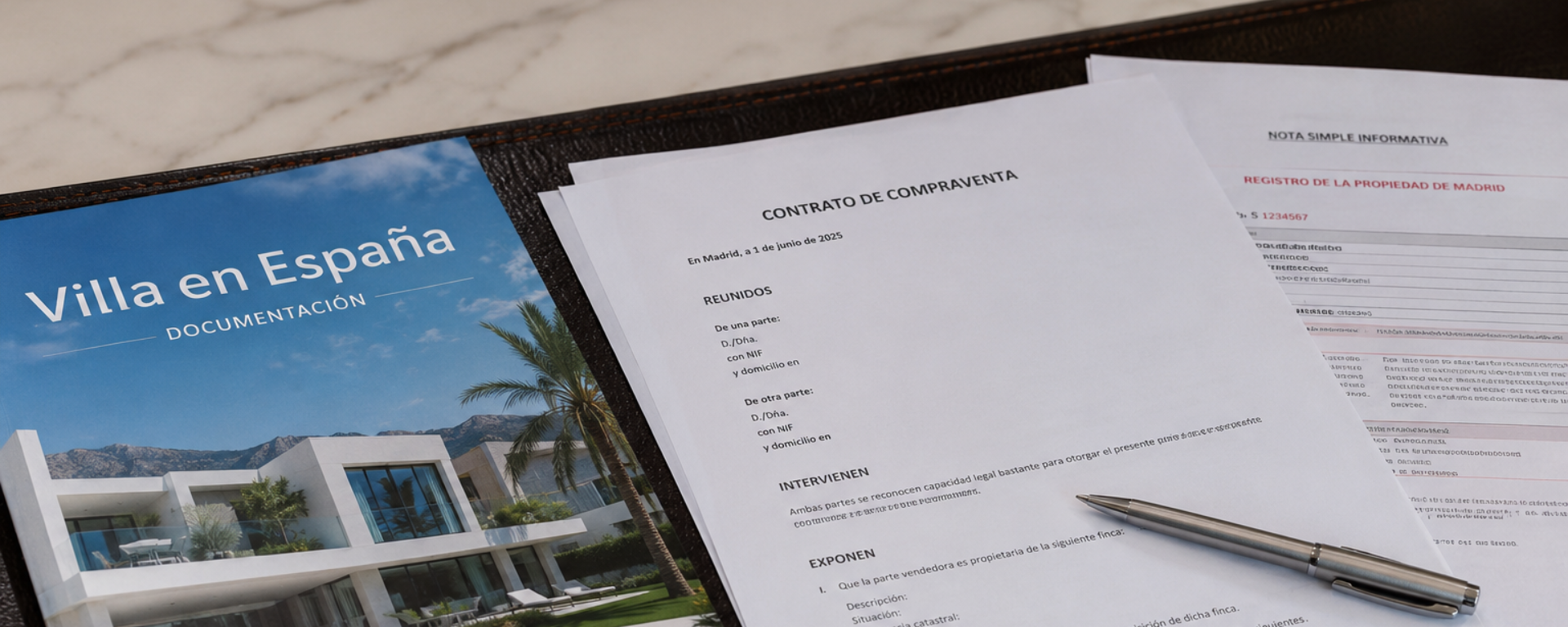

What documents are required to sell property in Spain in 2026
Reading time: ~3 minutes
Selling property in Spain involves far more than finding a buyer and agreeing on a price. A successful transaction begins long before the deed is signed before a notary.
Having a complete and well-prepared set of documents helps prevent delays, builds buyer confidence, and significantly streamlines the sales process.
During the first months of 2026, residential property prices in Spain continued to reach record highs, while demand remained strong, driven by sustained economic growth, limited housing supply, and continued interest from international buyers. In this market, properties with fully prepared documentation tend to sell faster and pass legal due diligence with fewer complications.
Below is an overview of the key documents required when selling property in Spain.

Proof of ownership
The primary ownership document is the Escritura Pública de Compraventa (Public Deed of Sale), the notarised deed that confirms legal ownership of the property.
If the property was acquired through inheritance or a gift, the corresponding notarised deed registered with the Spanish Land Registry must also be provided.
Land registry extract (Nota Simple)
A Nota Simple is an official extract from the Spanish Land Registry that confirms the current legal owner and identifies any existing mortgages, liens, charges, or other encumbrances affecting the property.
It is typically the first document requested by a prospective buyer or their lawyer during the legal due diligence process.
Energy performance certificate
As of 2026, energy certification requirements in Spain have become even more significant as part of the European Union’s strategy to improve the energy efficiency of buildings.
The Energy Performance Certificate (Certificado de Eficiencia Energética) is mandatory when selling property. It assigns an energy efficiency rating ranging from A to G and must remain valid at the time of completion.
Failure to provide a valid certificate may result in administrative penalties and can delay or complicate the sale.
Certificate of occupancy (Cédula de Habitabilidad)
For residential properties, another mandatory document is the Cédula de Habitabilidad (Certificate of Occupancy).
This certificate confirms that the property meets the minimum legal standards for safety, sanitation, and habitability and may be legally used as a residence. In most Spanish autonomous communities, it is required not only for the sale of a residential property but also for arranging new utility contracts and, in many cases, obtaining mortgage financing.
If the certificate has expired, it is advisable to renew it before marketing the property in order to avoid delays during the transaction.
Latest IBI tax receipt
The seller must provide proof of payment of the latest IBI (Impuesto sobre Bienes Inmuebles), Spain’s annual municipal property tax.
This confirms that there are no outstanding municipal tax liabilities.
Certificate of no outstanding community fees
If the property is part of an apartment building or residential development, the seller must obtain a Certificado de Deuda Cero from the Community of Owners.
This certificate confirms that all community fees have been paid in full. Without it, the notary cannot complete the transaction.

Mortgage documentation
If the property is subject to an existing mortgage, the seller must provide information regarding the outstanding loan balance.
In most transactions, the mortgage is redeemed on the day of completion, after which its cancellation is formally registered with the Land Registry.
Documentation for renovations or alterations
Where renovations or structural alterations requiring official approval have been carried out, it is advisable to provide the relevant building permits, technical documentation, and completion certificates.
This is particularly important for detached houses, villas, and commercial properties.
Additional documents for commercial property
When selling commercial real estate, buyers generally require additional documentation that enables them to assess not only the property’s legal status but also its future operating costs and investment potential.
Typically, investors request:
• Nota Simple confirming ownership and any registered encumbrances;
• the latest IBI tax receipt;
• a certificate confirming there are no outstanding debts to the Community of Owners (Comunidad de Propietarios);
• the most recent minutes of the Community of Owners’ meetings (Actas de la Comunidad) to identify any planned capital works or future extraordinary contributions;
• valid operating licences, where applicable;
• the current lease agreement and tenant information if the property is being sold as an investment asset.
These documents allow investors to accurately evaluate future obligations, operating costs, and the property’s long-term investment potential.

Seller’s сosts
Before placing a property on the market, it is also important to assess the tax implications of the sale.
The seller’s main costs may include:
• Capital Gains Tax (IRPF) on any profit realised from the sale;
• Plusvalía Municipal, the municipal tax based on the increase in the cadastral value of the land;
• mortgage cancellation costs, if applicable;
• fees associated with obtaining certificates and preparing the necessary documentation.
Calculating these costs in advance helps avoid unexpected financial obligations after completion.
Why documentation should be prepared before the property Is listed
In practice, most delays occur not during price negotiations but during the legal due diligence stage.
When all documentation has been prepared in advance, transactions progress more efficiently, and buyers gain greater confidence in the transparency and legal security of the property.
At Estate Barcelona, this is why the documentation process begins before a property is brought to market. We conduct a preliminary legal review, help owners prepare the complete documentation package, and ensure that all required checks are completed in advance.
This proactive approach minimises risk, shortens transaction times, and provides buyers with complete transparency throughout the acquisition process. With more than 20 years of experience in the Spanish real estate market, we have found that thorough preparation is one of the key factors behind a smooth and successful property sale.